Lawrence County Dog Registration Information
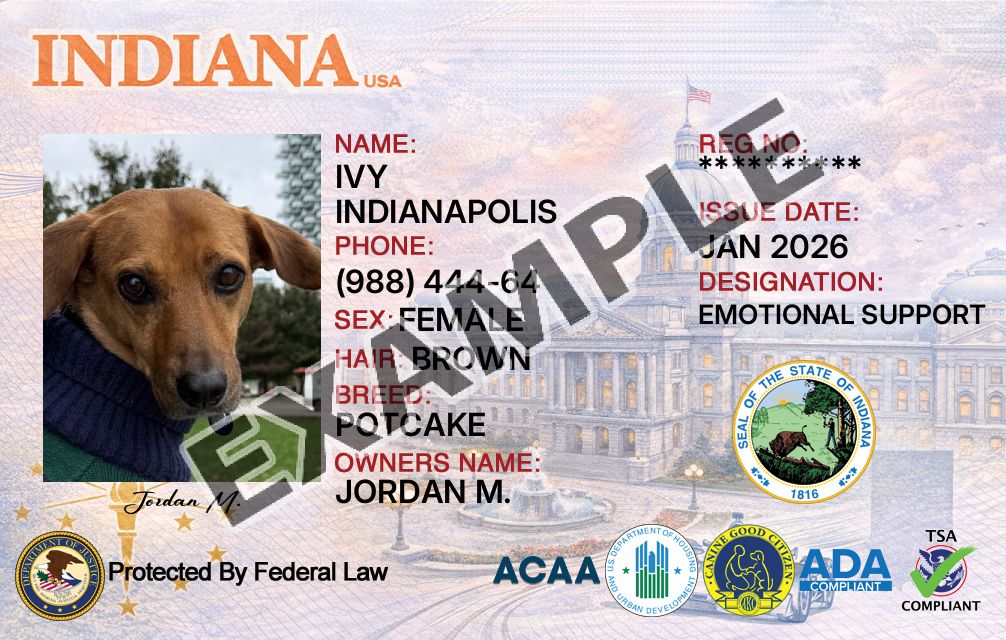
Service Dogs and Emotional Support Animals in Lawrence, Indiana
If you’re asking “where do I register my dog in Lawrence County, Indiana for my service dog or emotional support dog,” the key point is that dog licensing (local registration) and service dog / emotional support animal (ESA) status are separate issues. In many places, a dog license is handled locally (city or county), usually tied to rabies vaccination proof, while service dog and ESA status come from different legal frameworks rather than a single universal government registry.
- There is no one universal federal “service dog registry” or “emotional support animal registry.”
- Your dog may still need a local dog license (where required by your city/municipality), even if the dog is a service dog or an ESA.
- Proof of current rabies vaccination is commonly required under Indiana rules for dogs 3 months and older.
Where to Register or License Your Dog in Lawrence County, Indiana
The most relevant official contacts for “dog license in Lawrence County, Indiana” typically involve (1) local city licensing (where a municipal ordinance requires a license) and (2) county public health functions related to rabies and bite investigations. If you live in an incorporated city/town within Lawrence County, check whether your municipality requires a license; if you live in a rural/unincorporated part of the county, requirements may differ.
Lawrence County Health Department (Environmental Health Division)
City of Lawrence (Indiana) Animal Control (for residents inside City of Lawrence limits)
Lawrence County, Indiana licensing may be handled at the municipal level (city/town offices) rather than a single countywide “dog license bureau.” If you live in Bedford, Mitchell, or another incorporated area, contact your local city/town government to confirm whether a dog license is required and where fees/tags are issued.
Overview of Dog Licensing in Lawrence County, Indiana
What “dog registration” usually means locally
When people search for “where to register a dog in Lawrence County, Indiana,” they typically mean a local dog license (sometimes called a tag or registration). A dog license is a local requirement that helps identify dogs, support animal control operations, and encourage rabies vaccination compliance.
County vs. city rules in Indiana
Indiana does not operate a single statewide dog licensing system. Instead, dog licensing requirements often come from:
- City or town ordinances (for residents inside municipal limits)
- County-level practices related to public health (rabies rules, bite reporting, quarantine procedures)
- Enforcement and animal services that may be coordinated through local government and/or contracted facilities
Rabies vaccination is a baseline requirement
In Indiana, dogs (as well as cats and ferrets) 3 months of age and older must be vaccinated against rabies, and owners must maintain vaccination as required by the vaccine schedule. Proof of rabies vaccination is commonly requested when a local dog license is issued.
What You Need Before Registering a Dog
Common documents and information
While specific “dog licensing requirements Lawrence County, Indiana” can vary by municipality, most local licensing processes ask for:
- Rabies vaccination certificate (current)
- Rabies tag number (if provided by your veterinarian)
- Owner identification (such as a driver’s license or state ID)
- Proof of address/residency (especially if licensing is city-based)
- Spay/neuter documentation (if your local fees differ based on altered status)
- Payment method accepted by the issuing office
Service dog or ESA paperwork: what matters and what doesn’t
For licensing purposes, many local offices focus on rabies vaccination and owner/contact information. Service dog or ESA status generally does not replace public health requirements like rabies vaccination, and it typically does not remove the need to follow local licensing rules where they exist.
Steps to Register or License a Dog in Lawrence County, Indiana
Step 1: Confirm where you live (city/town vs. unincorporated county)
Start by identifying whether your address is:
- Inside an incorporated city/town (e.g., Bedford, Mitchell, etc.), which may have its own dog licensing ordinance and issuing office; or
- In an unincorporated area of Lawrence County, where requirements may be handled differently or may not exist as a formal “license” program.
Step 2: Get rabies vaccination (or confirm it is current)
If your dog is 3 months or older, schedule rabies vaccination with a licensed veterinarian or verify your dog’s vaccination is current. Keep the certificate in a safe place; many people also keep a digital photo.
Step 3: Contact the correct local office to ask about licensing
If you are trying to locate the “animal control dog license Lawrence County, Indiana” process, your best starting points are:
- Your city/town government office (for licensing rules, fees, and where tags are issued)
- Lawrence County Health Department (Environmental Health) (for rabies-related questions, bite reporting, and public health guidance)
Step 4: Apply, pay any required fees, and keep your records
If a dog license is required where you live, submit the paperwork and payment, then keep your receipt and license/tag information with your pet records. If tags are issued, attach them per the office’s instructions.
Service Dog Laws in Lawrence County, Indiana
Service dogs are defined by training and disability-related work
A service dog is generally understood (under federal disability law) as a dog that is individually trained to do work or perform tasks for a person with a disability. The legal status comes from:
- Whether the handler has a disability (as legally defined), and
- Whether the dog is trained to perform specific tasks directly related to that disability
No single federal “service dog registration” requirement
There is not one universal federal government registry you must use to “register” a service dog. In everyday situations, what matters is the dog’s training and behavior, and whether the dog performs disability-related tasks.
Local licensing still may apply
Even if your dog is a service dog, local rules (where they exist) can still require compliance with public health measures like rabies vaccination and, in some areas, a local dog license.
Emotional Support Animal Rules in Lawrence County, Indiana
ESAs are different from service dogs
An emotional support animal (ESA) is an animal that provides comfort by being with a person. ESAs are not the same as service dogs because they are not required to be trained to perform specific disability-related tasks.
No one universal government ESA registry
Like service dogs, ESAs are not “registered” through one universal federal system. If you are seeking accommodations (most commonly in housing contexts), the paperwork typically centers on the person’s need for the animal rather than a government-issued registration card.
Local dog licensing may still apply
If your city or town requires a dog license, ESA status usually does not replace that requirement. You should still be prepared to show rabies vaccination proof and follow any local rules for licensing and animal control.
Dog License vs. Service Dog vs. Emotional Support Animal (Comparison)
| Category | Dog License (Local) | Service Dog | Emotional Support Animal (ESA) |
|---|---|---|---|
| What it is | Local registration/license for a dog, created by city/town ordinance or local practice | A dog individually trained to perform tasks for a person with a disability | An animal that provides emotional comfort/support (not task-trained in the same way) |
| Who issues it | Local government office (often city/town clerk/controller) where required | No single issuing office; status depends on disability + training for tasks | No single issuing office; status is typically documented for accommodations (commonly housing) |
| Typical paperwork | Rabies vaccination proof, owner/contact info, payment, sometimes spay/neuter proof | Training documentation may exist privately, but not required as a universal “registration” | Documentation may exist for accommodations; not a universal registry or license |
| Rabies vaccination | Commonly required | Required under public health rules the same as other dogs | Required under public health rules the same as other dogs |
| Where to start in Lawrence County, IN | Start with your city/town office (if inside city limits) and keep rabies documentation | Focus on training, control, and applicable access/accommodation rules; still comply with local animal laws | Focus on the accommodation context; still comply with local animal laws |
Tip: Many searches for “service dog registration” really mean “local dog license” or “what paperwork do I need to show.” Those are separate topics, and local licensing requirements can vary by municipality.
Frequently Asked Questions
Register A Dog In Other Indiana Counties
Select your county below to get started with your dog’s ID card. Requirements and license designs may vary by county, so choose your location to see the correct options and complete your pup’s registration.
- Adams County Dog Registration
- Allen County Dog Registration
- Bartholomew County Dog Registration
- Benton County Dog Registration
- Blackford County Dog Registration
- Boone County Dog Registration
- Brown County Dog Registration
- Carroll County Dog Registration
- Cass County Dog Registration
- Clark County Dog Registration
- Clay County Dog Registration
- Clinton County Dog Registration
- Crawford County Dog Registration
- Daviess County Dog Registration
- Dearborn County Dog Registration
- Decatur County Dog Registration
- DeKalb County Dog Registration
- Delaware County Dog Registration
- Dubois County Dog Registration
- Elkhart County Dog Registration
- Fayette County Dog Registration
- Floyd County Dog Registration
- Fountain County Dog Registration
- Franklin County Dog Registration
- Fulton County Dog Registration
- Gibson County Dog Registration
- Grant County Dog Registration
- Greene County Dog Registration
- Hamilton County Dog Registration
- Hancock County Dog Registration
- Harrison County Dog Registration
- Hendricks County Dog Registration
- Henry County Dog Registration
- Howard County Dog Registration
- Huntington County Dog Registration
- Jackson County Dog Registration
- Jasper County Dog Registration
- Jay County Dog Registration
- Jefferson County Dog Registration
- Jennings County Dog Registration
- Johnson County Dog Registration
- Knox County Dog Registration
- Kosciusko County Dog Registration
- LaGrange County Dog Registration
- Lake County Dog Registration
- LaPorte County Dog Registration
- Madison County Dog Registration
- Marion County Dog Registration
- Marshall County Dog Registration
- Martin County Dog Registration
- Miami County Dog Registration
- Monroe County Dog Registration
- Montgomery County Dog Registration
- Morgan County Dog Registration
- Newton County Dog Registration
- Noble County Dog Registration
- Ohio County Dog Registration
- Orange County Dog Registration
- Owen County Dog Registration
- Parke County Dog Registration
- Perry County Dog Registration
- Pike County Dog Registration
- Porter County Dog Registration
- Posey County Dog Registration
- Pulaski County Dog Registration
- Putnam County Dog Registration
- Randolph County Dog Registration
- Ripley County Dog Registration
- Rush County Dog Registration
- Scott County Dog Registration
- Shelby County Dog Registration
- Spencer County Dog Registration
- St. Joseph County Dog Registration
- Starke County Dog Registration
- Stueben County Dog Registration
- Sullivan County Dog Registration
- Switzerland County Dog Registration
- Tippecanoe County Dog Registration
- Tipton County Dog Registration
- Union County Dog Registration
- Vanderburgh County Dog Registration
- Vermillion County Dog Registration
- Vigo County Dog Registration
- Wabash County Dog Registration
- Warren County Dog Registration
- Warrick County Dog Registration
- Washington County Dog Registration
- Wayne County Dog Registration
- Wells County Dog Registration
- White County Dog Registration
- Whitley County Dog Registration